
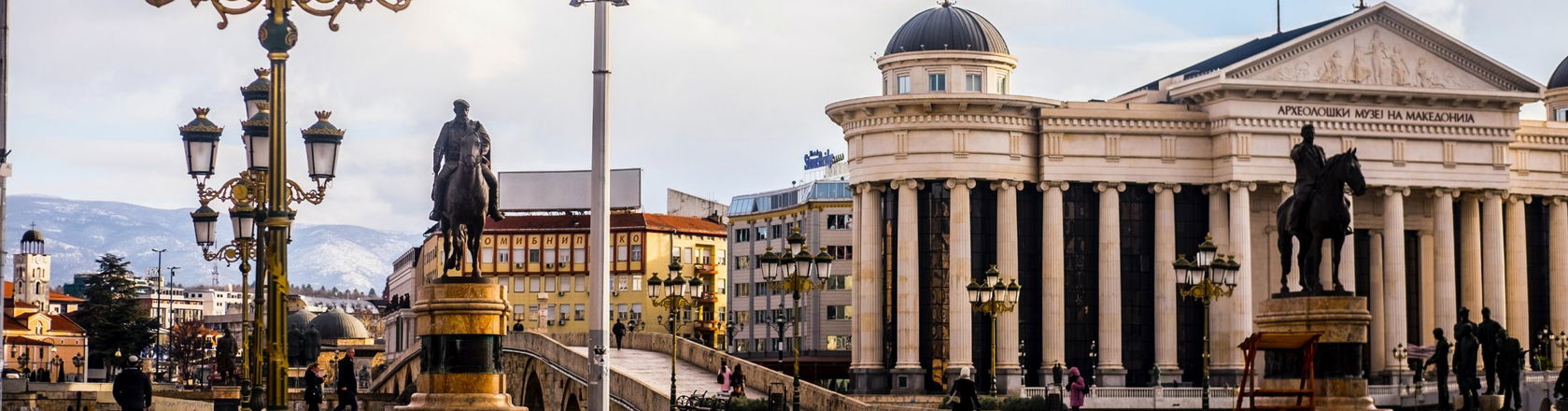
North Macedonia Economic Outlook
A small but resilient economy:
North Macedonia has undergone significant economic transformation since gaining independence from Yugoslavia in 1991. The economy is heavily reliant on trade, with exports of automotive components, textiles, and metals playing a major role. Despite political instability in the past, the country has managed to sustain moderate economic growth, though it remains one of the poorer economies in Europe.
Foreign investment and industrial zones:North Macedonia has attracted foreign direct investment (FDI) by establishing special economic zones offering tax incentives and simplified regulations. Major multinational companies, particularly in the automotive sector, have set up manufacturing operations in the country. The low corporate tax rate and competitive labor costs have also helped position North Macedonia as an attractive destination for investment.
Challenges in employment and governance:Unemployment, particularly among young people, remains high, despite improvements in recent years. The informal economy is also sizable, limiting tax revenues and reducing the efficiency of public services. Political uncertainty and occasional tensions with neighboring countries have posed risks to investor confidence, though recent agreements with Greece and Bulgaria have improved regional relations.
North Macedonia’s economic outlook:Our panelists’ economic forecasts for North Macedonia are for steady growth in the coming years, supported by strong exports, infrastructure projects, and EU integration efforts. However, long-term prospects will depend on structural reforms, improvements in education and labor market policies, and the successful implementation of EU accession requirements.
North Macedonia's Macroeconomic Analysis:
Nominal GDP of USD 15.8 billion in 2023.
GDP per capita of USD 9,165 compared to the global average of USD 10,589.
Average real GDP growth of 2.3% over the last decade.
Sector Analysis
In 2021, services accounted for 70.9% of overall GDP, manufacturing %, other industrial activity 21.5%, and agriculture 7.6%. Looking at GDP by expenditure, private consumption accounted for 65.9% of GDP in 2021, government consumption 16.3%, fixed investment 33.8%, and net exports -16.0%.International trade
In 2020, manufactured products made up 83.8% of total merchandise exports, mineral fuels 1.4%, food 9.8%, ores and metals 4.5% and agricultural raw materials 0.4%, with other categories accounting for 0.1% of the total. In the same period, manufactured products made up 64.7% of total merchandise imports, mineral fuels 7.9%, food 10.5%, ores and metals 16.1% and agricultural raw materials 0.8%, with other goods accounting for 0.0% of the total. Total exports were worth USD 7.30 billion in 2024, while total imports were USD 10.60 billion.Main Economic Indicators
Economic growthThe economy recorded average annual growth of 2.3% in the decade to 2023. To read more about GDP growth in North Macedonia, go to our dedicated page.
Fiscal policy
North Macedonia's fiscal deficit averaged 3.9% of GDP in the decade to 2023. Find out more on our dedicated page.
Unemployment
The unemployment rate averaged 20.5% in the decade to 2023. For more information on North Macedonia's unemployment click here.
Inflation
Inflation averaged 3.1% in the decade to 2024. Go to our North Macedonia inflation page for extra insight.
Monetary Policy
North Macedonia's monetary policy rate ended 2024 at 5.55%, up from 3.25% a decade earlier. See our North Macedonia monetary policy page for additional details.
Exchange Rate
From end-2014 to end-2024 the denar weakened by 14.4% vs the U.S. dollar. For more info on the denar, click here.
Economic situation in North Macedonia
North Macedonia’s GDP growth likely eased slightly in Q4 from Q3. Still, available data is mixed. Retail sales rebounded year on year after contracting in Q3, and goods exports growth accelerated, matching Q2’s over-two-year high. In addition, economic sentiment averaged higher in Q4 than in Q3. On the downside, industrial production growth posted its worst-performing quarter of the year in Q4. Looking to Q1 2026, our panelists see GDP growth improving slightly from Q4. In other news, the Thessaloniki–Skopje fuel pipeline recently resumed operations after 13 years of inactivity, boding well for energy security. North Macedonia also signed a trade deal with the U.S., removing all tariffs on U.S. industrial and agricultural imports, and plans to start purchasing U.S. LNG once a new pipeline from Greece is completed.North Macedonia Economic Forecasts
Projections out to 2035.48 indicators covered including both annual and quarterly frequencies.
Consensus Forecasts based on a panel of 15 expert analysts.
Want to get insight on the economic outlook for North Macedonia in the coming years? FocusEconomics collects projections out to 2035 on 48 economic indicators for North Macedonia from a panel of 15 analysts at the leading national, regional and global forecast institutions. These projections are then validated by our in-house team of economists and data analysts, and averaged to provide one Consensus Forecast you can rely on for each indicator. This means you avoid the risk of relying on out of date, biased or outlier forecasts. Our Consensus Forecasts can be visualized in whichever way best suits your needs, including via interactive online dashboards , direct data delivery and executive-style reports which combine analysts' projections with timely written analysis from our in-house team of economists on the latest developments in the North Macedonia economy. To download a sample report on the North Macedonia's economy, click here. To get in touch with our team for more information, fill in the form at the bottom of this page.