

Timeline of Events
Q4 2023: Following the October 7 Hamas attacks, Israel mobilized 360,000 reservists. The Houthi attacks in the Red Sea began, spiking insurance premiums and choking Eilat’s port traffic.
2024: Conflict between Israel and Lebanon intensified, causing severe economic damage in Lebanon. Israel’s credit rating took a historic hit (Moody’s, Fitch and S&P all cut the country’s rating within the year) as the fiscal deficit widened.
Q1-Q3 2025: Ceasefire talks collapsed repeatedly in Cairo and Doha. Israel and Iran engaged in a two-week missile exchange in June which saw broad swathes of Israel’s economy shut down temporarily.
Q4 2025: Israel and Hamas reached a peace deal in October, though some Israeli military action in the Gaza Strip continues. Sanctions on Iranian oil exports were tightened by the U.S. administration, targeting the “Ghost Fleet” carrying crude to China.
Economic Impact on Israel: The High Price of Total War
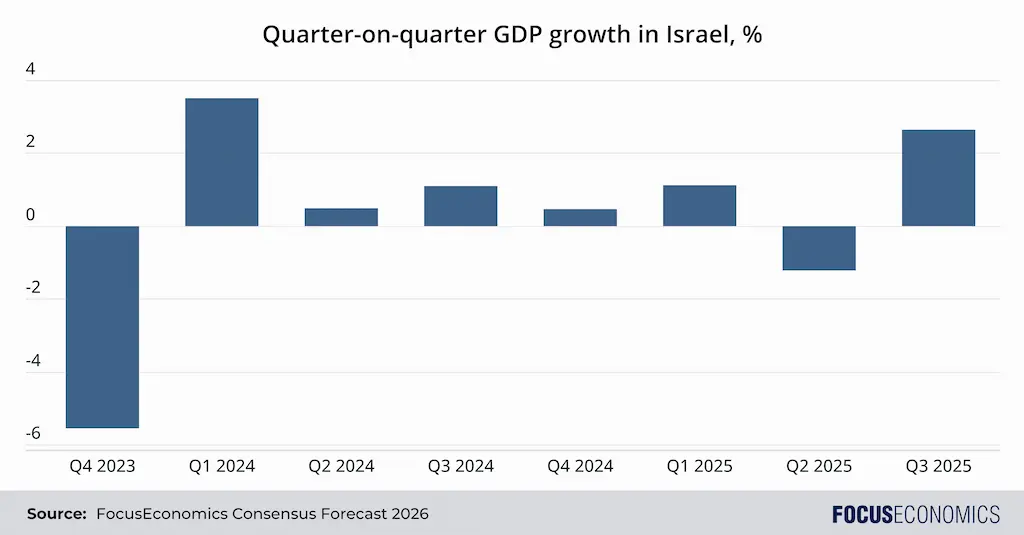
As covered in greater detail in a blog post devoted exclusively to Israel, the economy saw a severe immediate hit from the decision to attack Hamas. In the fourth quarter of 2023, GDP contracted by 5.5% on a quarterly basis. Slumping tourism, weak investor and consumer sentiment, the call-up of reservists, disruption to agriculture along the Gaza border and the ban on Palestinian workers—important in agriculture and construction—all took a toll. Though the economy has since recovered, as recently as Q2 2025 output was below its pre-war level, as the missile exchange with Israel led to the shutdown of businesses in the quarter. Moreover, given rapid population growth of around 2% per annum, GDP per head is still lower than before conflict with Hamas started.
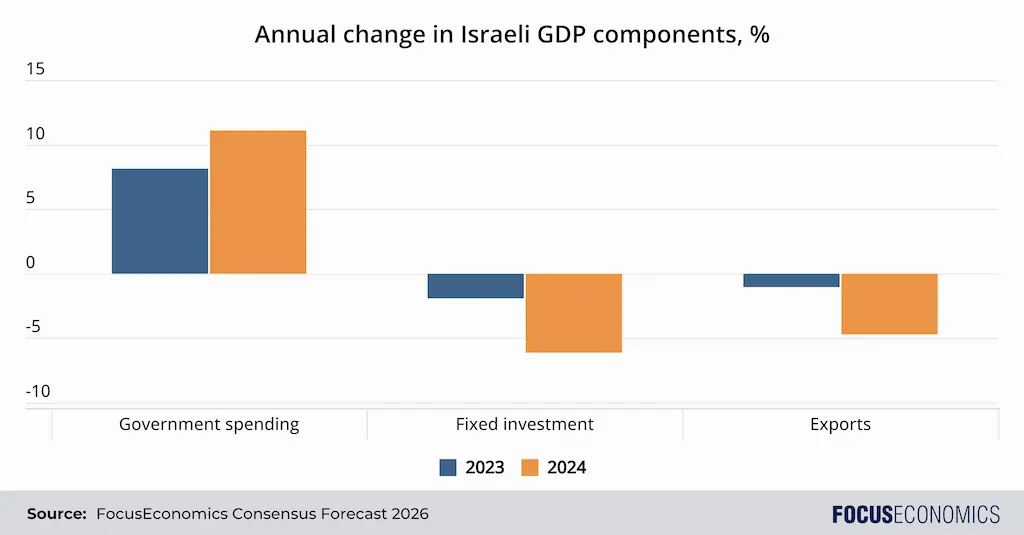
One notable development has been the change in the composition of GDP growth. While in the decade before the war began growth was fairly balanced, since the war government consumption has been almost the only major driver. The defense budget for 2024 ballooned to 7% of GDP, among the highest rates globally, resulting in a gaping fiscal deficit and exploding public debt. In contrast, investment and exports declined in 2023 and 2024, contrasting notable expansions on average in the previous ten years.
Even Israel’s vaunted tech sector has shown cracks. Though some tech metrics have been strong—the value of acquisitions and IPOs in 2025 has been several times higher than in 2024 for instance, others are less encouraging. High-tech production has stalled recently; the pool of R&D personnel is contracting; start-up formation and total tech employment growth have both fallen below their levels of the past decade; and venture-capital fundraising is in decline. Moreover, investments in Israeli startups are concentrated in cybersecurity and enterprise software, showcasing a lack of diversity that makes the sector vulnerable to any changes in the fortunes of those two subsectors.
Economic Impact on Iran: Sanctions, Missiles, and Economic Siege
Even before June’s missile exchange with Israel, Iran was already suffering from multiple malaises: Stagnating oil production, falling oil prices, U.S. sanctions, corruption and economic mismanagement, drought and one of the world’s highest inflation rates. Elevated defense spending and the billions channeled to Hezbollah, Hamas, Iraqi militias and the Houthis over the past decade have diverted resources from infrastructure, healthcare and jobs. The brief war with Israel only heaped on more misery.
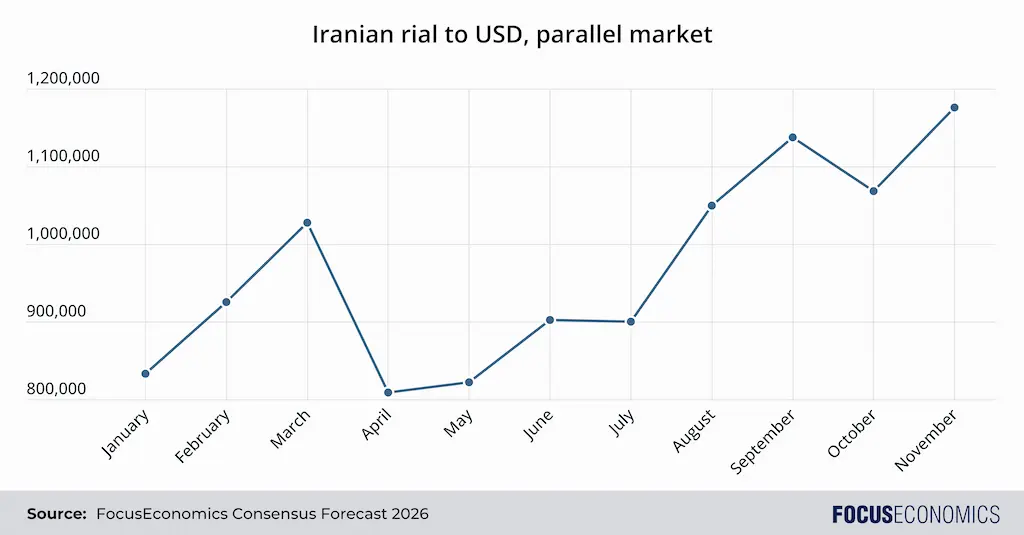
Israel’s strikes targeted critical infrastructure including the South Pars gasfield—which produces most of Iran’s natural gas output—the Shahr Rey refinery outside Tehran, multiple fuel depots and military assets. They also caused the closure of Iranian airspace, weighed on consumer and business sentiment, and led to a renewed slump in the parallel currency. In response, Iran suspended co-operation with the International Atomic Energy Agency, leading to a snap-back of UN sanctions in September.
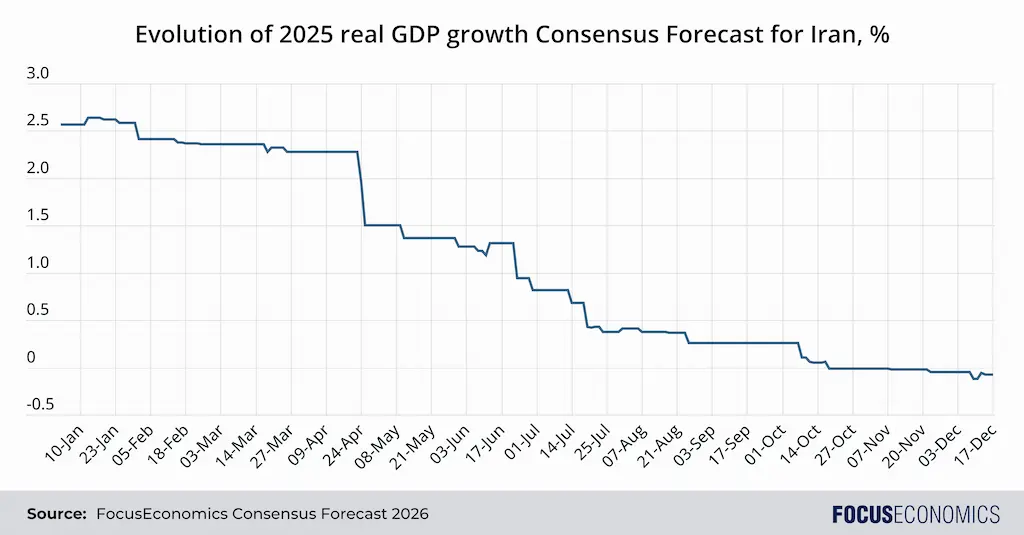
As a result of all this, our panelists’ forecasts for 2025 GDP growth have fallen from slightly above 1% on the eve of the conflict to around 0% today, with the economy projected to stagnate again in 2026.
Economic Impact on Lebanon: From Crisis to Catastrophe
Lebanon’s economy was already in free fall before a single Israeli bomb dropped. Between 2018 and 2023, GDP plummeted by over a third, the currency lost most of its value and inflation rose to triple figures as the result of a prolonged banking crisis, port explosion and political dysfunction. Conflict between Israel and Lebanese militia Hezbollah during late 2024 led to USD 14 billion in damages and economic losses according to the World Bank—a perfect example of the contagion risk we spoke of in a 2023 blog post.
Housing bore the brunt, with around USD 5 billion in damages, with agriculture and tourism also affected. The conflict also led to large-scale population displacement, which reached 1.4 million by late October 2024. As a result, our Consensus is for GDP to have fallen for a seventh straight year in 2024, and to be nearly 40% smaller than the 2017 peak.
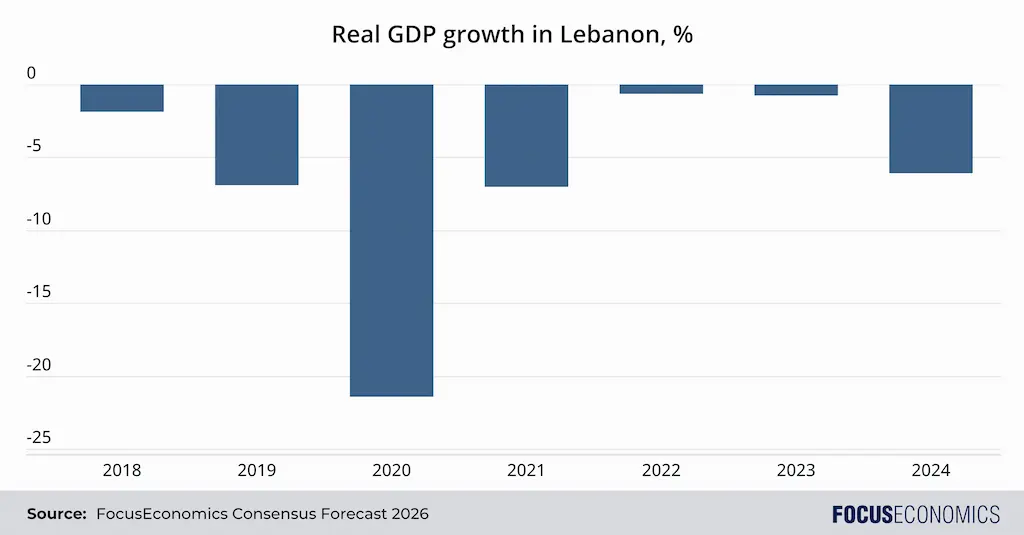
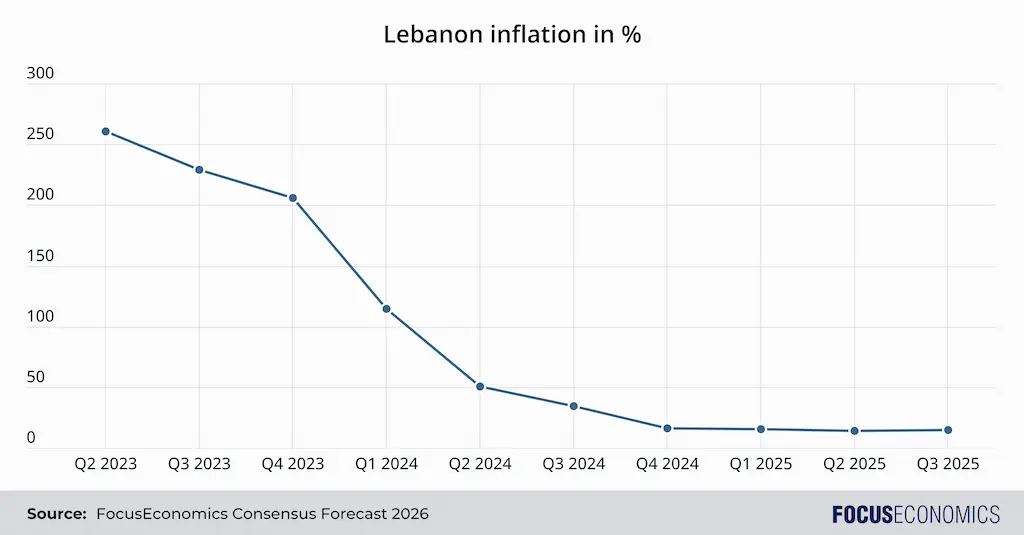
That said, the economy has likely returned to growth in 2025. Numerous factors should have underpinned the turnaround, namely the Israel-Hezbollah truce, lower inflation and the formation of a new government in early 2025 after more than two years of political paralysis. On inflation, there was some initial fear that Israel-Hezbollah conflict could cause a resurgence in price pressures. In the end this didn’t come to pass, with inflation plateauing in the mid-teens, a far cry from the 200%+ values reached in 2023.
Economic Impact on Gaza: A precipitous economic collapse
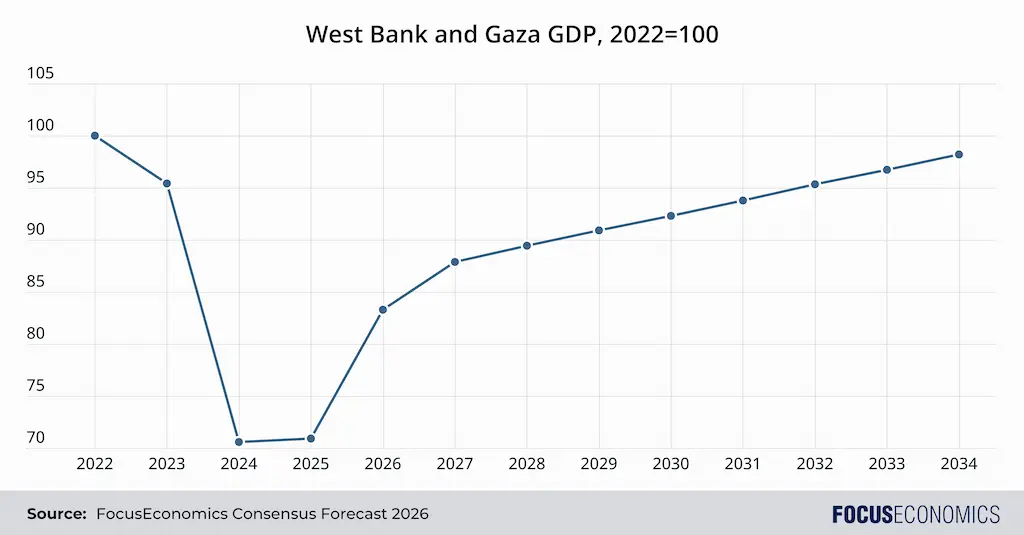
As is to be expected, economic output in Gaza and the West Bank has plunged since Israel’s war on Hamas began as a result of massive destruction and population displacement. Gaza has fared the worst. Reconstruction costs there exceed USD 70 billion. Simply removing rubble could take 22 years based on past reconstruction efforts, while clearing unexploded ordnance may require up to 10 years. However, the West Bank has also suffered from falling fiscal revenues and employment, with many Palestinians who had crossed into Israel for work no longer able to do so.
According to our Consensus Forecast, the GDP of Gaza and the West Bank is expected to remain below its pre-crisis level even at the middle of the next decade. Even that forecast is likely based on no major resumption of massive conflict as well as the entry of reconstruction funds—both open questions given the shaky state of the peace deal between Israel and Hamas.
Comparative forecasts between the four countries
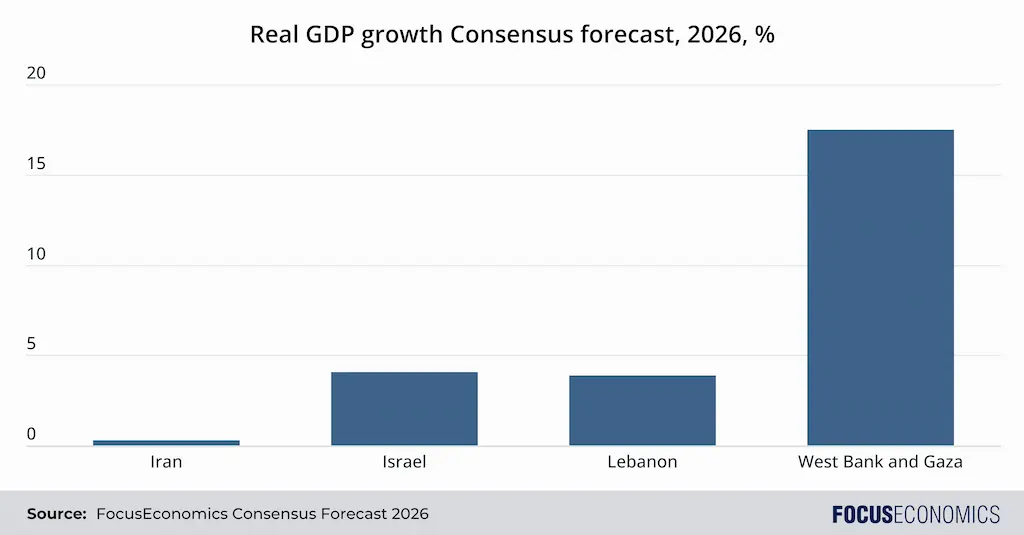
Looking at our Consensus forecasts for 2026, the West Bank and Gaza is forecast to see the fastest growth, as the reduced intensity of fighting allows for some measure of economic recovery. However, the economy will remain over 15% smaller than pre-war levels.
Meanwhile, both Israel and Lebanon should see similar growth rates of close to 4%. In Israel’s case growth will be underpinned by reduced fallout from the Israel-Hamas war plus lower interest rates. However, fiscal consolidation will muzzle government spending after several years of large budget deficits to finance the war.
In Lebanon’s case, lower inflation, some structural economic reform momentum as well as strong tourism and remittances will be important drivers. However, any largescale resumption of hostilities between Israel and Hezbollah could prove a major economic setback; an Israeli strike on a building in Beirut in late-November highlights how real this risk is.
Iran’s trajectory is bleaker, with economic stagnation forecast for 2026 due to sky-high inflation, Western sanctions, weak oil prices and plateauing crude output.
For more information on these or any of the other 198 countries we cover, or for the latest on our new subscribers portal and how it can help your business, get in touch here.