

Understanding the quickest-growing economies
Upon examining the top 10 fastest-growing economies, as reflected in our Consensus Forecast, several common trends emerge. Most nations will be in Africa—particularly sub-Saharan Africa—highlighting how a continent once synonymous in the West with poverty and famine is now increasingly a source of economic dynamism. Only two will be in the Asia-Pacific, one in the Middle East and one in the Americas. Most nations in the top 10 remain poor in GDP per capita terms. This should come as no surprise, as fast GDP growth is easiest when a country’s stock of human and physical capital is low. When looking at the key growth drivers across countries, one in particular stands out: Increased natural resource extraction, especially of hydrocarbons. This driver underpins our panelists’ forecasts for Guyana and most of the African economies featured in the top ten. Recovery from armed conflict is another recurring theme: In South Sudan, Palestine and Libya, economic fallout from recent conflicts has created a favorable base effect for 2026 GDP growth. That said, the threat of future violence remains a key downside risk to the economic outlook for these and several other countries in this list.
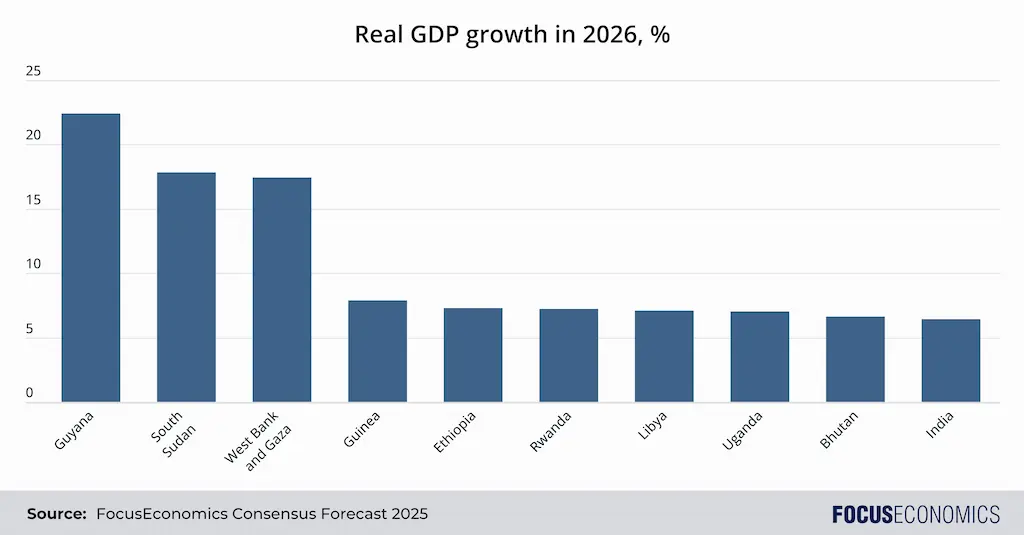
Fastest growing economy in the world
1. Guyana: 22.4%
Guyana’s GDP growth will be the fastest in the world in 2026 according to our Consensus Forecast, as has been the case in recent years. An oil bonanza is behind the favorable projections: Oil production rose from virtually zero in 2019 to over 600,000 barrels per day (bpd) to around 900,000 by late 2025, and should continue to ratchet up going forward. The ensuing boom in fiscal revenue will fuel the public spending required to meet the country’s development needs. That said, there are numerous risks to the outlook. The burgeoning energy sector could lead to cronyism and weaken institutions, as well as divert resources away from manufacturing and services. Ethnic tensions and protests are further clouds on the horizon. Tensions with unstable neighbor Venezuela are an additional risk, with Venezuelan President Maduro threatening to annex Guyana’s oil-rich Essequibo region.
Remaining top-ten countries with the highest economic growth
2. South Sudan: 17.8%
South Sudan’s GDP growth will be the world’s second-highest in 2026. But while the projection looks impressive, it is the result of a highly favorable base of comparison; the economy shrank 26% in 2024 due to spillovers from the war in neighboring Sudan. The war caused supply disruptions and damaged a pipeline carrying over two-thirds of South Sudanese oil, leading exports to tumble and inflation to skyrocket. The bounce-back in gross domestic product since then is linked largely to the resumption of oil flows via the pipeline to Sudan. An intensification of conflict in Sudan, disruptions in Red Sea trade and extreme climate events are downside risks.
3. West Bank and Gaza: 17.4%
The peace deal between Israel and Hamas in late 2025 should allow some semblance of economic recovery in the West Bank and Gaza in 2026, despite periodic Israeli attacks. That said, GDP will remain far smaller than its pre-crisis level, having shrunk around 30% from 2023 to 2025. A return to full-frontal fighting between Israel and Hamas is the main downside risk.
4. Guinea: 7.9%
This military-led African nation should see its economic growth next year powered by rising earnings from exports of diamonds, gold, bauxite and iron ore, the latter linked to the Simandou mine. The mine is a major infrastructure project for the country, and once fully operational will make Guinea one of the world’s leading iron ore producers. Construction has cost USD 20 billion and involved building a 650km railway line and accompanying port, all to extract iron ore reserves that could be worth several hundred billion dollars in total.
5. Ethiopia: 7.3%
Ethiopia’s GDP growth will be spurred in 2026 by structural reforms and billions of dollars in support from international partners such as the IMF and World Bank. Having liberalized the exchange rate in mid-2024, the government’s policy focus is now on boosting domestic revenues, reforming state-owned enterprises and restructuring debt. That said, elevated inflation and tight financial conditions—partly the result of sharp currency depreciation following the move to a floating exchange-rate regime—will cap economic activity. Moreover, a delay to agreeing debt restructuring terms, the possible end of a fragile peace deal in the Tigray region and active insurgencies in the Amhara and Oromia regions present major risks to the outlook.
6. Rwanda: 7.2%
Rwanda’s GDP has boomed in recent decades, with GDP per capita rising more than tenfold since the end of the genocide in the mid-1990s. The country’s stable political environment, lack of corruption, and strong state-led development plan have all aided growth. Our panelists expect GDP growth in 2026 to be broad-based, with large expansions in private spending, fixed investment and exports. Government spending will grow at a comparatively modest rate due to some fiscal consolidation following an election-related spending boost in 2024. The authorities will continue to focus on their “Made in Rwanda” initiative designed to boost domestic manufacturing, as well as large infrastructure projects such as a new international airport that the government hopes will become a continental travel hub.
7. Libya: 7.1%
In a somewhat similar fashion to South Sudan, Libya’s rapid economic growth projection for 2026 is partly the result of a favorable base of comparison. The country has been riven by armed conflict and political instability since civil war broke out in 2011—it still has two competing governments controlling separate areas of the country—and then had to contend with the fallout from the Covid-19 pandemic. As such, Libya’s GDP is still notably smaller than before the civil war, providing ample scope for catch-up growth. The ramp-up of energy production will be a key growth driver for next year, with fluctuations in oil prices and the volatile security situation the key risks.
8. Uganda: 7.0%
Uganda’s GDP growth in 2026 will be driven by heavy investment tied to the construction of a 1,400km oil pipeline to Tanzania, plus other major oil developments and supporting infrastructure. Fixed investment in manufacturing and logistics should stay strong, aided by the government’s increasing reliance on public-private partnerships to ease fiscal constraints. Outside the energy sector, the staged rollout of the standard-gauge railway linking Uganda to Mombasa plus the enlargement of special economic zones will also be important growth drivers.
9. Bhutan: 6.6%
Bhutan—a diminutive, landlocked country in the Himalayas—is expected to see robust economic growth in 2026 powered by factors such as heavy hydropower investment, financial support from international donors, targeted fiscal incentives for rural SMEs, streamlined customs and strong tourism activity. Moreover, government revenues should benefit from a 5% goods and services tax to be levied from January 2026.
10. India: 6.4%
Our Consensus is for industry and services to be the key drivers for India’s GDP growth next year, with agriculture to expand at a comparatively moderate rate. India will benefit from its burgeoning, young population, manufacturing investment by international firms looking to pivot away from China, interest rate cuts by the Central Bank, and moderating inflation. This will mark a continuation of the country’s impressive growth trajectory since the early 1990s. GDP per capita is around seven times higher than it was then, with India now among the top-five largest economies globally. A flare-up in border disputes with China plus further trade tensions with the U.S. are depreciatory risks.
Future Projections for the Countries with the Highest GDP Growth
Looking beyond 2026, most of the 10 economies mentioned above should maintain strong economic growth rates of over 5% per annum, spurred by infrastructure investment, rising populations and further gains in the extractive sector—in particular the energy industry. That said, the economies of the West Bank and Gaza, Libya and South Sudan will slow sharply as easy catch-up growth following damage from past armed conflicts fades.
Originally published in December 2017, updated in December 2025