

Volatility is rising: Late last month the VIX index, the stock market’s ‘fear gauge’, hit the highest level since April, a month which had marked a post-pandemic high after Trump shook markets with his reciprocal tariffs.
In recent months, a chorus of figures including Nassim Taleb (risk analyst and author of The Black Swan), Larry Fink (CEO of Blackrock) and Jamie Dimon (CEO of JPMorgan) have sounded alarm bells about this recent increase in volatility, with the latter stating in October that “there continues to be a heightened degree of uncertainty” in the world economy.
What does that imply for you, your business or investments?
Consensus forecasts have historically been more accurate: At FocusEconomics, our goal is to help businesses and investors plan for the future by providing accurate projections about what will happen to the world economy and financial markets in the future.
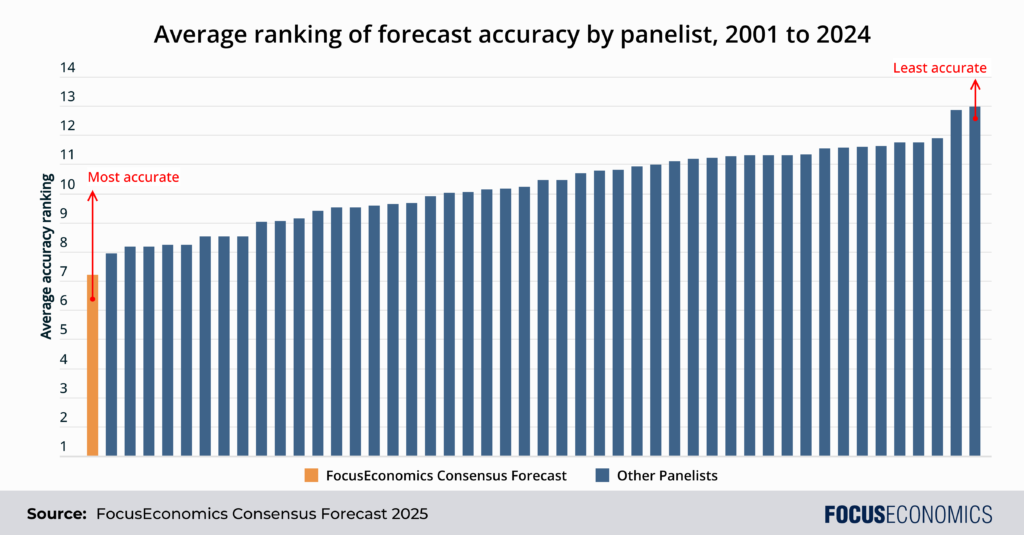
Our Consensus Forecasts have historically been more accurate than individual projections; one expert might be off the mark, but 40+ experts are unlikely to be (you can learn more about some of our 1,000+ panelists here).
The below graph illustrates this: It ranks each panelist’s average accuracy in the panels they participated in from 2001 to 2024 (where 1 = the most accurate in a given panel).
(Note: Because panelists do not appear in every panel, even the least accurate panelist’s average ranking will be lower than the total number of panelists.)
Does this record still hold true?
Does increasing uncertainty in the world economy mean that forecasts are fruitless, outdated as soon as the ink they’re written with dries?
Real-time forecasts enable more nimble decisions: Toyota, the world’s top car manufacturer, is one client of FocusEconomics that thinks differently. While others freeze, it moves. The company is well-known for its ‘Just In Time’ approach to production plans, “making only what is needed, only when it is needed, and only in the amount that is needed”.
In May, its North American division decided to extend the production forecast it shares with its suppliers from 13 to 52 weeks. Moreover, it decided to replace 75 labor-intensive spreadsheets with consolidated, cloud-based forecasting tools. This allows the company to offer its suppliers greater certainty despite tariffs and rocky geopolitics whiplashing supply chains.
In the age of uncertainty, forecasts don’t fail. They just need to move as fast as the world does.
FocusEconomics extends its product: To meet this challenge, in 2023 FocusEconomics began offering daily updates of our Consensus Forecasts. Along with snippets of the latest analysis from our panel of economists, this allows businesses and investors to make decisions that reflect the economic outlook of the present rather than the past. In addition to PDF and Excel formats, these forecasts can be accessed via our FocusAnalytics data platform or API, making their integration with cloud-based forecasting models easy.
Below are some recent examples:
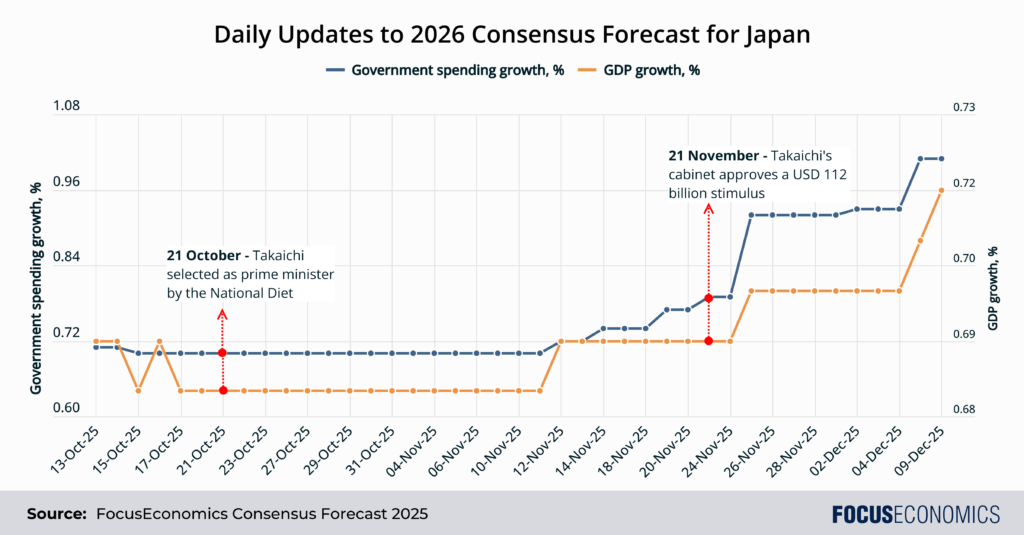
Big-spending Takaichi elected as Japanese Prime Minister: After taking office in October, Prime Minister Sanae Takaichi, long a proponent of fiscal stimulus, approved a USD 112 billion supplementary budget in November, prompting our panelists to raise GDP and government spending forecasts for 2026.
EIU analysts said:
“Owing to a larger-than-expected fiscal stimulus package of ¥21.3trn (US$135bn) unveiled in late November, we have revised our forecast for the fiscal deficit to the equivalent of 3% of GDP in 2026 and 2.9% of GDP in 2027, from our previous expectation of 2.7% in both years. We expect Ms Takaichi’s plan for industrial reinvigoration and defence enhancement to keep the deficit elevated during the forecast period.”
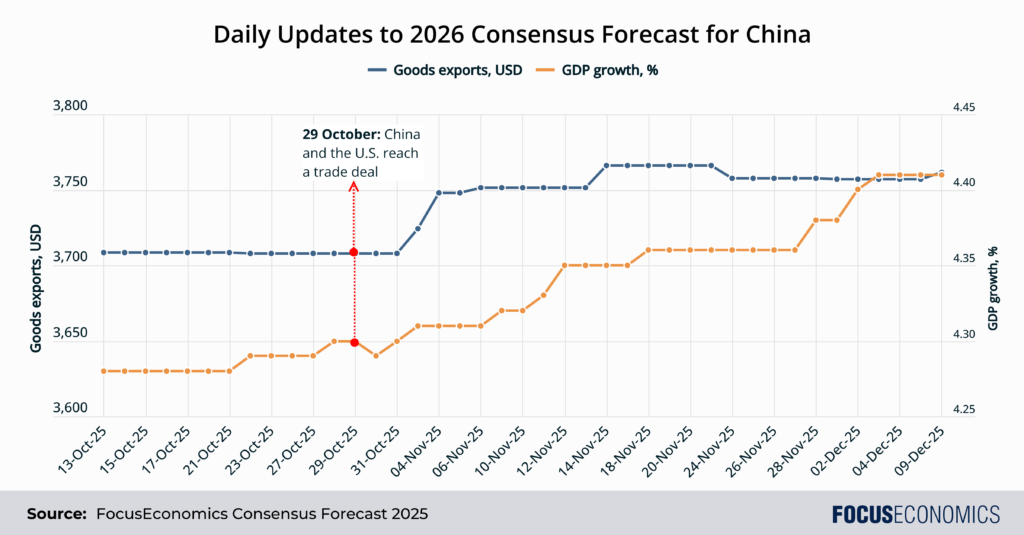
China and the U.S. reach a trade deal: China and the U.S. agreed to a trade deal on 29 October, preventing–albeit likely temporarily–a tariff war between the two countries like that seen in April. As a result, our panelists raised their forecasts for China’s exports and GDP next year.
Economists at Fitch Ratings said:
“Over 20-30 October, the US announced deals with China, Japan, Korea, Vietnam, Malaysia, Thailand, Australia and Cambodia […]. We expect these developments to have a small positive impact on economic growth in China and the US over 2026-2027. Some other Asian countries, especially Korea and Vietnam, should also see an uplift through the influence of stronger demand in China and the US.”
In today’s volatile world, forecasts need not just to be accurate, but also agile. The key is to move while others freeze.